
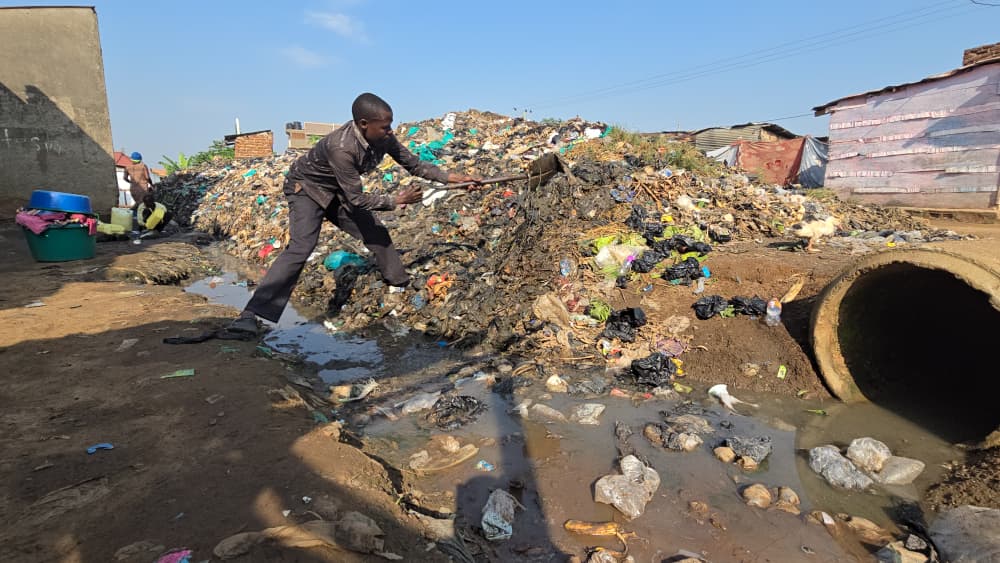
As communities across Uganda participated in the country's inaugural National Cleaning Exercise, residents of Mission Cell in Mbale City used the occasion to draw attention to a long-standing garbage crisis that continues to threaten public health and expose glaring sanitation inequalities.
While the nationwide exercise aimed to promote cleaner and healthier communities, residents of the informal settlement said years of appeals for intervention have gone unanswered, leaving them to live alongside a growing mountain of waste.
By dawn, Mbale's usually busy streets were unusually quiet as businesses remained closed and residents, local leaders, security agencies and government institutions took part in the voluntary clean-up exercise.
Along the Mbale–Tororo Road, Uganda People's Defence Forces (UPDF) officers stationed at the Senior Officers' Quarters and the Regional Wazalendo SACCO headquarters enforced the government's directive by requiring boda boda riders and pedestrians heading into the city to join the clean-up.
Participants swept roads, slashed overgrown vegetation, cleared blocked drainage channels and collected litter.
In the city centre, the exercise proceeded voluntarily, with traders and residents cleaning pavements, shop fronts and surrounding public spaces.
Mbale City Mayor Joyce Matandwa Kidulu, Deputy Resident City Commissioner Yahya Were, councillors, technocrats and officials from the Uganda Wildlife Authority joined residents in the exercise.
The mayor described the turnout as a sign of growing public appreciation for environmental cleanliness.
"We've had the business community, the general public and institutions participate. That signals the community's desire for a clean city," Kidulu said.
She said the exercise was intended not only to remove waste but also to encourage behavioural change.
"This is changing mindsets because people have been disposing of garbage indiscriminately. As we clean, we are sensitising people and challenging every individual to understand that keeping the environment clean is our responsibility. I have urged shop owners to maintain cleanliness around their premises," she added.
Despite the success of the city-wide exercise, residents of Mission Cell said their biggest challenge remains unresolved.
They pointed to a large garbage heap that has accumulated over several years despite repeated complaints to city authorities.
Residents say the waste has become a breeding ground for disease, exposing the community to foul odours, flies and mosquitoes while contaminating a water source that once served hundreds of households.
"This borehole was donated by the late Wapakhabulo. It was condemned and closed after tests revealed that the water was contaminated," one female resident said.
Although the water source was declared unsafe, many residents continue to rely on it because they cannot afford alternative sources.
During the clean-up exercise, children were seen collecting water from the contaminated spring, highlighting the difficult choices facing many low-income families.
For many households, the polluted spring remains the most accessible and affordable source of water.
Mission Cell LC I Chairperson Masheti Paul Muboki said the matter has repeatedly been raised with city authorities without success.
"I have brought it to the attention of division authorities, including the Health Inspector, Town Clerk and Mayor, but nothing has been done," Muboki said.
Residents said the clean-up exercise offered only temporary relief because the waste collected from drainage channels had nowhere to be taken.
Without a designated dumping site or garbage collection trucks, heaps of waste were left by the roadside, raising fears they would simply be washed back into drainage channels during the next rainfall.
Residents attributed the worsening situation to the abolition of the former public dumpsite system.
Mbale City now operates a public-private partnership model under which households are expected to hire licensed private garbage collectors.
However, residents argue that the arrangement is unaffordable for many families living in informal settlements.
Mbale City NRM Youth Chairperson and Mission Cell resident Pius Mude said the model does not adequately serve low-income communities.
"This system cannot work in slum areas. It may work in organised settlements like the Senior Officers' Quarters, where people can afford to pay private collectors. But here, after we sweep, where do we dump the waste? We have no designated collection point," Mude said.
For Mission Cell residents, the National Cleaning Exercise underscored the need for long-term investment in waste management, safe water sources and sanitation infrastructure rather than one-off clean-up campaigns.
Mbale City Council Speaker Matuka, who has been in office for about two months, acknowledged the sanitation challenge and said plans were underway to find a permanent solution.
"It is a big concern, and we are going to clean and ensure that Mbale returns to its glory," Matuka said.
Until sustainable waste management systems are established, residents fear the garbage crisis will persist long after the National Cleaning Exercise has ended.
